
Essential Lenses Every Photographer Should Own
Discover the essential lenses for beginner photographers; kit lenses, wide-angle primes, telephoto zooms, and portrait primes. Learn what each lens does, why it matters, and the best affordable recommendations for Canon, Nikon, Sony, Fujifilm, and Micro Four Thirds.
11/5/202510 min read
Why Lenses Matter More Than Camera Bodies
People often fixate on camera bodies, but lenses are what shape your images: they control perspective, light gathering (aperture), background blur (bokeh), and image character. A good lens will improve your photos more noticeably than upgrading camera bodies (Not to say there isn't a time to do so). However, after choosing a camera, finding a lens that works for you can be downright intimidating. There are hundreds of lens that serve unique purposes. It can be a challenge to find ones that fit your needs and creative style most efficiently. For beginners, a small, well-chosen set of lenses will cover most shooting situations and help you learn different styles of photography.
Below are four essential lens categories every beginner should understand and consider adding to their kit: kit lens, wide-angle prime, telephoto zoom, and portrait prime. For each category I explain what it does, when to use it, and practical lens recommendations across popular mounts.
Kit Lens : Your Versatile Starter Lens
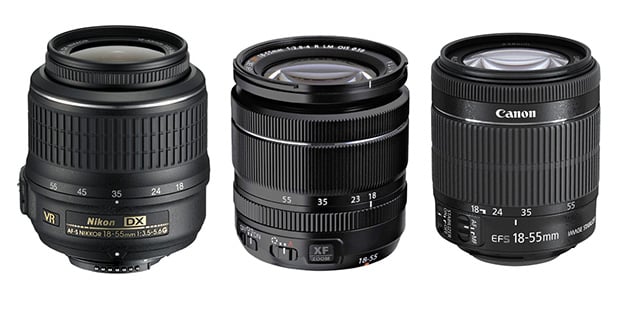
A “kit lens” is the general-purpose zoom typically sold with a camera, for example 18–55mm on APS-C or 24–70mm on some full-frame kits. It covers a wide range of common focal lengths so you can experiment without changing lenses. Kit lenses also tend to be lightweight and compact, which makes them great for travel or casual shooting. While they’re not as bright or sharp as professional lenses, they’re an excellent starting point for understanding how focal length, aperture, and composition affect your photos. Once you’ve spent time shooting with one, you’ll naturally start to discover what kind of lens you might want next
What it does / Why it’s important
The kit lens is where most beginners spend hours learning composition, framing, and exposure. It’s versatile: wide enough for interiors and some landscapes, and long enough for casual portraits. Modern kit lenses are surprisingly capable, especially stabilized versions, and are ideal for travel and learning.
When to use it
Travel and everyday shooting
Learning framing and composition
Situations where changing lenses is impractical
Things to watch for
Variable maximum aperture (e.g., f/3.5–5.6) limits low-light performance and background blur.
Image stabilization (IS/VR/IBIS compatibility) helps for handheld low-light shots.
Consider upgrading only when you know what you’re missing (e.g., low-light or shallow depth of field).
Recommended kit / starter zooms
Canon (APS-C): Canon EF-S 18–55mm f/4–5.6 IS STM (or RF-S 18–45/18–150 for R-series)
Nikon (APS-C): Nikon Z DX 16-50mm f/3.5–6.3 for Z-mount kit options or Nikon NIKKOR Z DX 16-50mm f/2.8 VR Lens (Nikon Z)
Sony (APS-C): Sony E 16–50mm f/3.5–5.6 PZ OSS II
Fujifilm (APS-C): Fujifilm XC 15–45mm f/3.5–5.6 OIS PZ
Micro Four Thirds: Olympus M.Zuiko 14–42mm or Panasonic 14–42mm kit zoom
Wide-Angle Prime : Expand Your Perspective
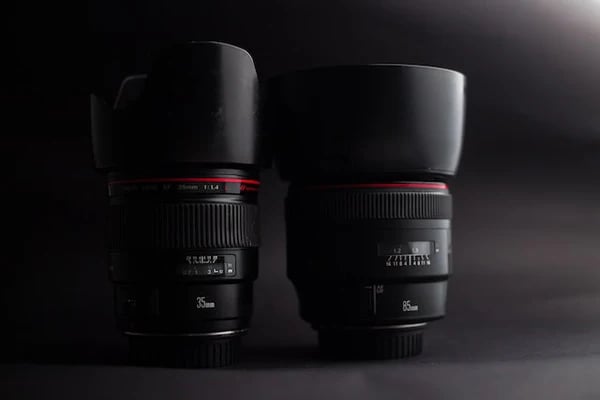
A wide-angle prime is a fixed focal length lens with a field of view wider than “normal.” On a full-frame camera, common wide-angle focal lengths include 24mm, 20mm, and 35mm, each offering a slightly different level of width. A 35mm lens is considered a mild wide-angle, ideal for street or documentary-style photography, while a 24mm or 20mm lens creates a more dramatic, expansive view that’s great for sweeping landscapes or architectural shots. On crop-sensor (APS-C) cameras, the equivalent focal lengths are smaller, typically 16–24mm, and on Micro Four Thirds systems, they’re even shorter, around 9–12mm, due to the sensor’s 2x crop factor.
Why it’s important
Wide primes are excellent for landscapes, architecture, environmental portraits, street photography, and interiors. Because a wide-angle prime has a fixed focal length, it doesn’t zoom in or out. Instead, you “zoom with your feet” by moving closer or farther from your subject. This limitation is actually an advantage for beginners; it helps train your eye to think about composition, framing, and perspective. Wide primes also tend to have larger maximum apertures (like f/1.8 or f/2.0), which means they perform better in low light and can create a pleasing background blur even at wider angles. Many are small, lightweight, and optically sharp, making them ideal for travel, street photography, or any situation where you want to shoot handheld and unobtrusively.
When to use it
Landscapes and cityscapes
Environmental portraits (showing subject + surroundings)
Tight interiors / travel photography
Tips for using wide angles
Keep horizons straight to avoid distortion.
Use the wide perspective to show context and storytelling.
Don't place a subject at the extreme edge; distortion can be flattering if used intentionally.
Recommended wide-angle primes
Full-Frame / Canon RF: Canon RF 24mm f/1.8 STM (lightweight and sharp)
Full-Frame / Nikon Z: Nikon NIKKOR Z 24mm f/1.8 S (higher-end but great optically)
Sony (FE): Sony FE 28mm f/2 (compact and budget-friendly) or FE 35mm f/1.8 for mild wide
APS-C / Fujifilm: Fujifilm XF 18mm f/2 R (approx 27mm equiv) or XF 23mm f/2 (35mm equiv feel)
Micro Four Thirds: Olympus M.Zuiko 17mm f/1.8 (34mm equiv, bright, compact)
Telephoto Zoom : Reach Far, Compress Perspective
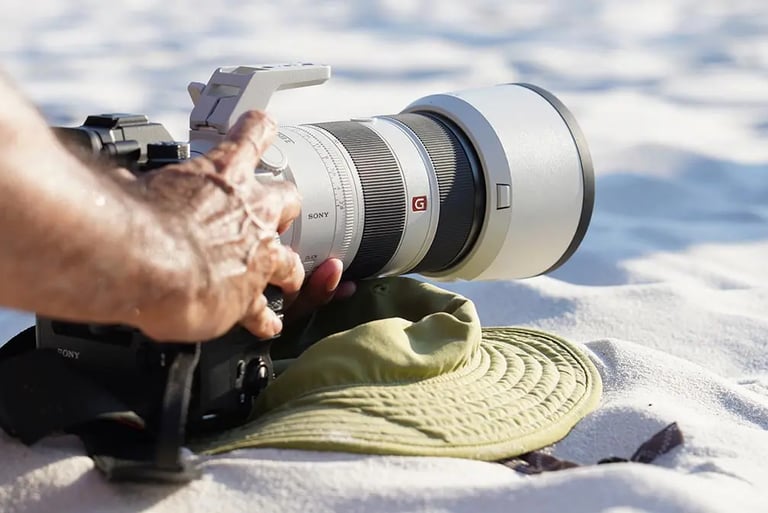
A telephoto zoom lens is designed for when you need to get closer to your subject without physically moving. These lenses cover longer focal lengths, typically ranging from 70–200mm, 55–250mm, or 18–135mm on APS-C cameras. They’re ideal for bringing distant subjects right into your frame — whether that’s a bird across the field, an athlete mid-action, or a candid moment at an event.
Unlike wide or standard lenses that emphasize space and context, telephoto zooms compress perspective — meaning they make the background appear closer to your subject. This optical effect not only flattens the scene slightly but also enhances background blur (bokeh), creating a soft, dreamy backdrop that helps your subject stand out. It’s one of the main reasons telephoto lenses are so loved for portrait photography: they make faces appear more natural and flattering, avoiding the distortion you sometimes get with wider lenses
Why it’s important
Telephoto zooms are essential tools for sports, wildlife, portrait, and event photographers. If you’ve ever tried to photograph someone on stage, an animal in the distance, or a detail across a landscape, you’ll know how valuable extra reach can be. With a telephoto zoom, you can capture expressive moments from far away without disturbing your subject all while maintaining image quality and control.
Another major advantage is framing flexibility. Because these lenses zoom across a range of focal lengths, you can easily recompose without having to move around. This is especially useful for fast-moving subjects or unpredictable shooting environments. Most telephoto lenses also feature image stabilization (IS, VR, or OSS) to reduce camera shake, which becomes more noticeable at longer focal lengths.
For beginners, telephoto zooms offer an exciting creative edge. They teach you to look for light and background separation, help you capture spontaneous moments from a distance, and open up possibilities
When to use it
Wildlife and sports (long reach)
Portraits with creamy background separation (85–135mm range on full frame)
Events and street photography when you can’t get close
Practical considerations
Longer focal lengths are more sensitive to camera shake, stabilization (IS/VR/OSS) helps, or use faster shutter speeds.
Larger telephoto zooms can be heavy; consider weight/portability for travel.
Recommended telephoto zooms
All-round APS-C tele: Canon EF-S 55–250mm f/4–5.6 IS STM (affordable, good reach)
All-round full-frame option: Tamron 28-200 F/2.8-5.6 Di III RXD or Sigma 70–200mm f/2.8 (lighter alternative to f/2.8 pro lenses)
Sony (E/FE) APS-C: Sony E 55–210mm f/4.5–6.3 OSS ( compact and stabilized)
Nikon Z (DX/full-frame): Nikon Z 70–300mm or Z 50–250mm equivalent for reach
Micro Four Thirds: Panasonic 45–150mm or Olympus 40–150mm f/4-5.6 (MFT has extra reach due to 2× crop factor)
Budget travel tele zoom: 55–200/55–250 options across Canon/Sony/Nikon, solid starter tele lenses
Portrait Prime : Create Beautiful Background Blur
A portrait prime lens is every photographer’s secret weapon for achieving that classic, professional “blurry background” look. These lenses have a fixed focal length, usually around 50mm, 85mm, or 105mm on full-frame cameras. On crop sensors, a 35mm or 50mm lens produces a similar field of view, giving you that natural, flattering perspective that’s perfect for portraits.
What makes portrait primes stand out is their wide maximum aperture, typically f/1.8, f/1.4, or even wider. This large aperture allows for a shallow depth of field, meaning your subject stays razor-sharp while the background melts into a smooth, creamy blur — also known as bokeh. This separation between subject and background adds visual depth and instantly gives your images a cinematic, professional quality.
Because portrait primes let in a lot of light, they also perform exceptionally well in low-light environments like indoor settings, evening golden hours, or dimly lit events without needing to raise your ISO too high or rely on a flash.
Why it’s important
Portrait primes are valuable not just for their image quality, but for how they shape the way you shoot. With a fixed focal length, you’re encouraged to move around your subject, explore different angles, and pay closer attention to composition and background elements. This constraint actually sparks creativity and helps you develop a stronger eye for framing.
These lenses also render flattering facial proportions because they don’t distort features the way wider lenses can. The mild compression of an 85mm or 105mm lens softens facial lines and gives a gentle, natural look; one reason portrait photographers love them.
For beginners, a good portrait prime is often the first “wow” lens, the one that transforms your photos from snapshots to professional-quality images. It teaches you how aperture affects background blur, how distance changes perspective, and how light interacts with your subject.
When to use it
Headshots and portraits
Engagements, family photos, and street portraits
Any time you want subject isolation and a soft background
Practical considerations
For full-body portraits in tight spaces, choose a shorter portrait focal (50mm). For headshots with strong separation, 85mm is ideal.
Wide apertures create extremely thin depth of field; nail focus on the eyes.
Recommended portrait primes
50mm (the “nifty fifty”):
Canon EF 50mm f/1.8 STM (DSLR), extremely affordable, great first lens
Canon RF 50mm f/1.8 STM (mirrorless), small and sharp
Sony FE 50mm f/1, budget full-frame option
85mm:
Canon RF 85mm f/2 Macro IS STM (good blend of sharpness + stabilization)
Sony FE 85mm f/1.8, popular mid-range portrait lens
Nikon Z 85mm f/1.8 S (for Z mount, higher-end)
APS-C alternatives: 35mm f/1.8 or 50mm f/1.8 give portrait-friendly focal lengths on crop bodies for Canon, Sony, Nikon, etc
Micro Four Thirds: Olympus 45mm f/1.8 (approx 90mm equiv), compact portrait favorite
How to Choose: A Simple Roadmap for Beginners
Start with your kit lens to learn focal lengths and composition.
Add one fast prime (50mm or 35mm equivalent) for low light and portraits — primes teach you to “move” rather than zoom.
Add a telephoto zoom if you shoot events, wildlife, or want more reach and background compression.
Consider a wide prime if you shoot landscapes, architecture, or indoor spaces often.
If you must pick only one extra lens as a beginner, a 50mm f/1.8 (or system-equivalent) is arguably the most versatile and affordable upgrade.
Final Thoughts
Lenses determine the look and possibilities of your photography more than camera bodies. For beginners, focus on a small set of high-value glass: a versatile kit zoom to learn with, a fast prime for portraits and low light, a telephoto zoom for reach and compression, and a wide prime if you love landscapes and interiors. Buy used if you want to save money, rent to test, and prioritize the focal lengths and apertures that match how you like to shoot. While a simple kit lens is great for learning the basics, as your skills progress you will quickly outgrow it and need to collect more specific lenses for situations that require a lens that a kit lens is not optimal for. While it is not necessary, having one or two different lenses for different scenarios can help elevate your photos to a professional level. These 4 lens types are what we recommend photographers keep with them but as you find your niche you can determine what lens work for you and which ones you won't really need.
Crop Factor, Stabilization & Adaptors
Crop factor matters. Every camera sensor has a size that influences how much of a scene your lens captures — this is called the crop factor. A full-frame sensor is considered the standard reference, while APS-C and Micro Four Thirds (MFT) sensors are smaller, effectively cropping the image and narrowing your field of view. For example, if you mount a 50mm lens on an APS-C camera, it behaves more like a 75–80mm lens on a full-frame camera. That means you’ll get a tighter frame which is perfect for portraits or subject isolation, but less ideal if you’re shooting wide landscapes. On Micro Four Thirds systems, the crop factor is 2x, so that same 50mm lens gives a field of view similar to 100mm on full-frame which is excellent for telephoto-style shots.
Understanding this helps you plan your lens purchases wisely. If you shoot on a crop-sensor camera, for instance, you might want a wider lens for landscapes or interiors to make up for the narrower field of view.
Image stabilization helps. Image stabilization (IS, VR, or OSS) is a powerful feature that compensates for small hand movements and vibrations when shooting handheld especially important for telephoto zooms and low-light photography. When you’re zoomed in, even the slightest shake can cause noticeable blur, and stabilization helps keep images crisp without needing a tripod. Some cameras include in-body image stabilization (IBIS), which moves the camera’s sensor to counteract motion. Others rely on lens-based stabilization. If your camera already has IBIS, pairing it with a non-stabilized lens still gives you solid results. However, when both the camera and lens have stabilization, they can often work together to give you even smoother performance. Good for video or long exposures.
Adapters expand choices. As the camera industry continues shifting toward mirrorless systems, lens adaptability has become a huge advantage. Using lens adapters, photographers can mount older DSLR lenses onto modern mirrorless bodies, preserving access to great glass from previous systems.
For example, a Canon EF lens can be used on a Canon RF or Sony E-mount body with the right adapter. There are a few trade-offs — adapters can sometimes add bulk, slightly reduce autofocus speed, or limit compatibility with certain electronic features, but they’re often worth it for the flexibility they provide. If you ever switch brands or upgrade from DSLR to mirrorless, adapters make it easier to reuse your existing lenses, saving you money while expanding your creative options.
Practical Buying Tips (Budget + Used Market)
Buy used to save: Lenses often outlast camera bodies. Reputable used sellers (local camera stores, B&H Used, KEH, MPB) offer great value.
Rent before you commit: Rent a lens for a weekend to see if the focal length and handling suit your style.
Watch for optical issues: On used lenses, check for haze, fungus, heavy scratches near the mount, or noisy AF.
Prioritize aperture and sharpness for portraits, focal range for travel, and stabilization for telephoto.
Sample 3-Lens Beginner Kit (Practical Builds)
Minimalist / Travel-friendly: Kit zoom (18–55) + 35mm f/1.8 prime (wide-normal)
Portrait + Events: Kit zoom + 50mm f/1.8 (portrait) + 55–250mm tele zoom (reach)
Landscape / Architecture: Wide prime (24/16/17mm) + kit zoom for flexibility




Learn
Explore tips and techniques for photography.
Affiliate Disclosure
Some of these post/pages contain affiliate links. As an Amazon Associate and other retailers such as B&H Photo and Video I may earn from qualifying purchases. I only recommend gear and resources that I personally use, have tested, or truly believe in. Any support you give by purchasing through these links helps allows me to continue creating free content. Thank you!
Connect
Support
contact@brightformfocus.com
© 2025. All rights reserved.